
Alfalfa: how to ensure successful summer plantings?
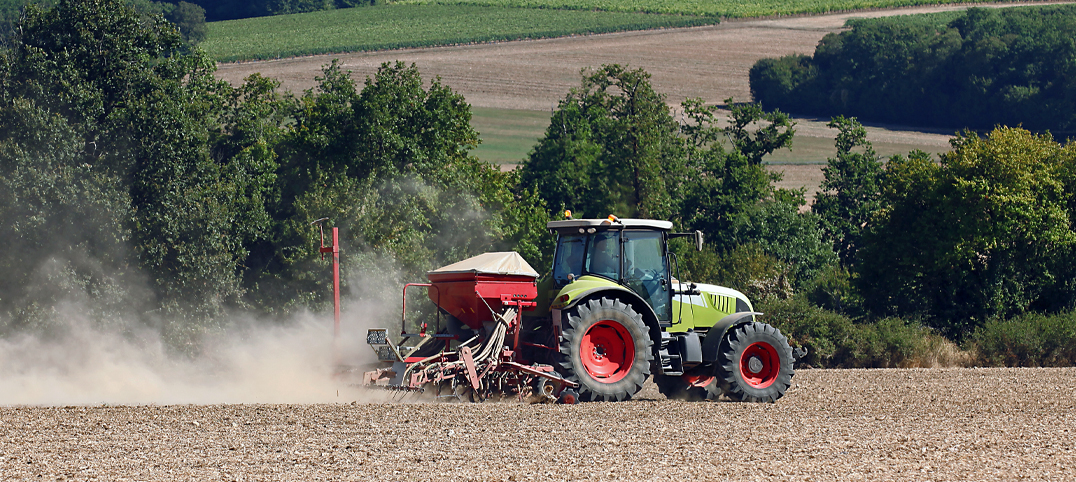
The success of an alfalfa crop is determined right from the start. The choice of plot, sowing time, quality of soil preparation and breeding program all have a direct impact on the crop’s productivity and persistency. Before sowing, there are a few essential rules to follow to give yourself the best possible chance of success.
1. Choosing the right plot: the first step towards success
Alfalfa is a demanding species that only reaches its full potential in a favourable environment.
Three points deserve particular attention:
• Healthy, well-drained soil: alfalfa is sensitive to excess water and hydromorphic conditions, which damage its root system.
• A deep, uncompacted soil structure: the root pivot must be able to penetrate deeply to ensure a reliable water supply during dry periods.
• Well-balanced fertility: Phosphorus, potash and calcium are the most important elements to check. A pH above 6.5 is recommended to ensure proper establishment.
To assist with this decision-making process regarding plot selection, myLuzerne app developed by Cérience enables you to assess a plot’s potential and identify any potential limiting factors before planting. Available on Android and iOS, this free of charge tool will allow you, in just a few minutes, to confirm your choice with complete objectivity! 
2. Summer sowing: prioritise early planting
The aim of summer sowing is to allow the crop to benefit from 6 to 8 weeks of growth before the first frosts arrive.
In soil that is still warm, alfalfa generally benefits from rapid crop emergence and active growth, which help the plant to establish its taproot and build up its initial reserves. The earlier the planting, the more secure the crop’s potential will be for the following year.
Recommended periods for summer sowing
• North-East: before 10 August;
• North-West and Centre: before 30 August;
• South-West: before 10 September;
• South-East: before 20 September.
Once the seeding date has passed, water availability often remains the most decisive factor. Sowing carried out under good moisture conditions will generally be preferable to early sowing in soil that is too dry.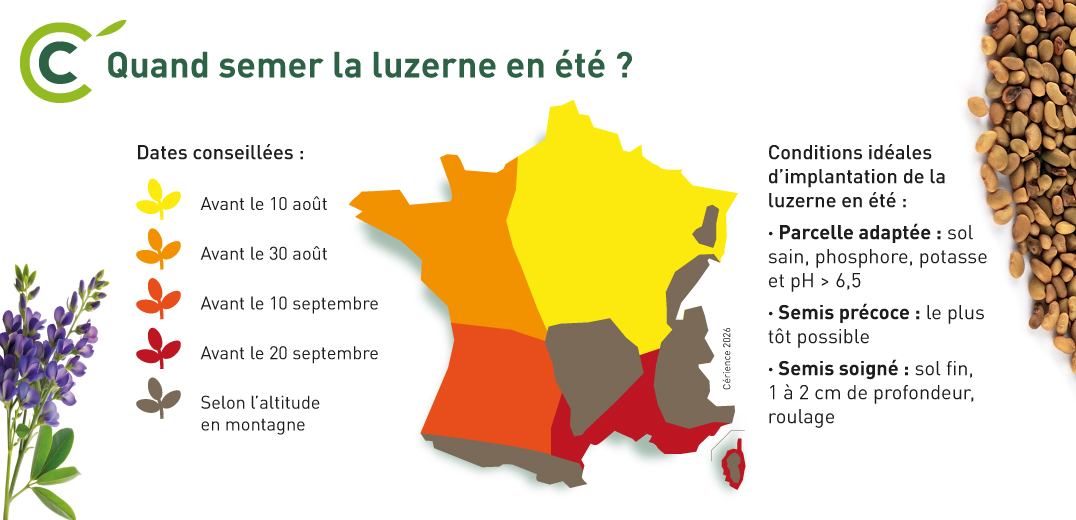
3. Crop management practices: key principles to follow
Prepare a fine seedbed: given the small size of alfalfa seeds, soil preparation must result in fine, well-levelled soil on the surface to ensure good soil-seed contact and promote uniform crop emergence.
Observe the correct sowing depth: the ideal depth is between 1 and 2 cm. Sowing too deep severely hinders crop emergence and reduces the final stand. Rolling the seedbed after sowing also improves soil-seed contact and helps draw moisture up from the soil.
Promote nodulation: seed inoculation helps to promote the rapid establishment of the symbiotic relationship with the rhizobium responsible for atmospheric nitrogen fixation. This symbiosis plays a vital role in the initial vigour and longevity of the alfalfa.
4. Which alfalfa variety should you choose?
The choice of variety will be determined by several criteria: geographical location, production objectives and management system, in particular. Among the many varieties offered by Cérience, here is a selection of three very different variety profiles:
LUXURY (Fall dormancy index 3.9), the new benchmark!
A high-yielding variety, LUXURY stands out for its high protein content, consistent production and good resistance to major diseases. A solution designed for Livestock Farmers or the hay and silage sector seeking both yield and quality.
LIMORY (Fall dormancy index 2.2), genetics innovation to cope with climatic uncertainties
LIMORY, the first varia type alfalfa variety marketed by Cérience, has a more pronounced dormancy period and a late spring early growth stage. Its potential is particularly concentrated in the first cuts, making it an attractive variety for regions prone to summer droughts. Its abundant foliage and slender stems are particularly appreciated by Livestock Farmers.
ALFAMAX, a variety mixture of four varieties designed for consistency
ALFAMAX combines four elite varieties with complementary profiles. Thanks to the diversity of dormancy periods (2.2 to 6.5), the mixture provides greater yield consistency between cuts, stable yields and good tolerance to diseases and nematodes. A versatile solution suited to a wide range of production contexts.
In summary
In summer, a successful alfalfa planting rests primarily on three pillars:
- A suitable plot;
- Sowing early enough;
- Careful planting.
Combined with the right choice of variety, these factors will enable the crop to establish itself well before winter and reach its full potential next spring!
Of course, rain is, and always will be, an essential key to success for alfalfa, just as it is for all crop types.