
Cover crops: 5 good reasons to switch to broadcast sowing before harvest
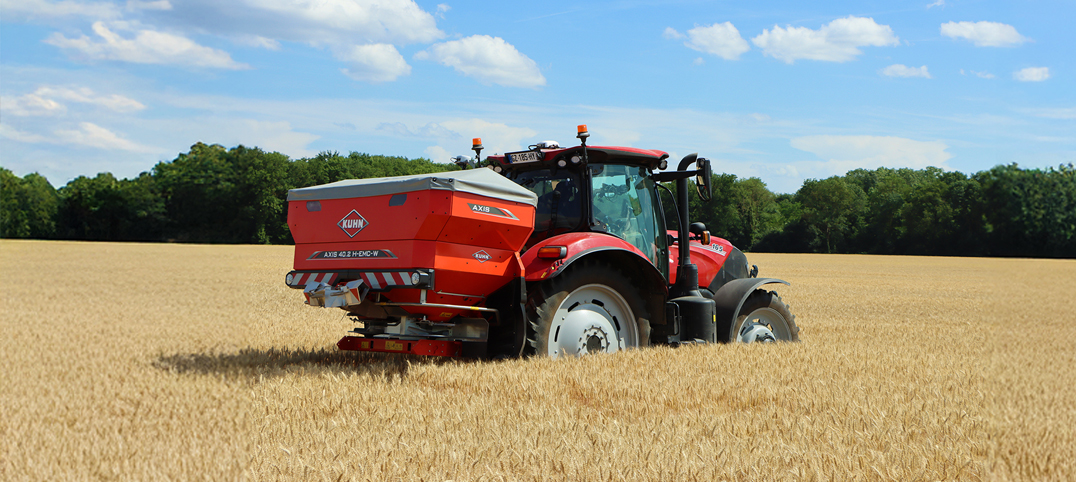
As the summer season begins, the first cereal harvests are fast approaching: in less than two months, the combine harvesters will be out in the fields. Against this backdrop, many of you are already thinking about the post-harvest period and, in particular, the catch crop establishment: defining agronomic objectives, choosing species, purchasing seeds and planting techniques.
In this new issue of Point Culture, we focus on a technique that is rapidly gaining ground in the field: broadcast sowing of cover crops before harvest. A practice that sometimes challenges established habits, but which addresses very practical challenges, such as saving time, controlling costs and improving agronomic performance.
Here are the 5 key benefits of this technique that makes all the difference.
1. A technique now fully mastered
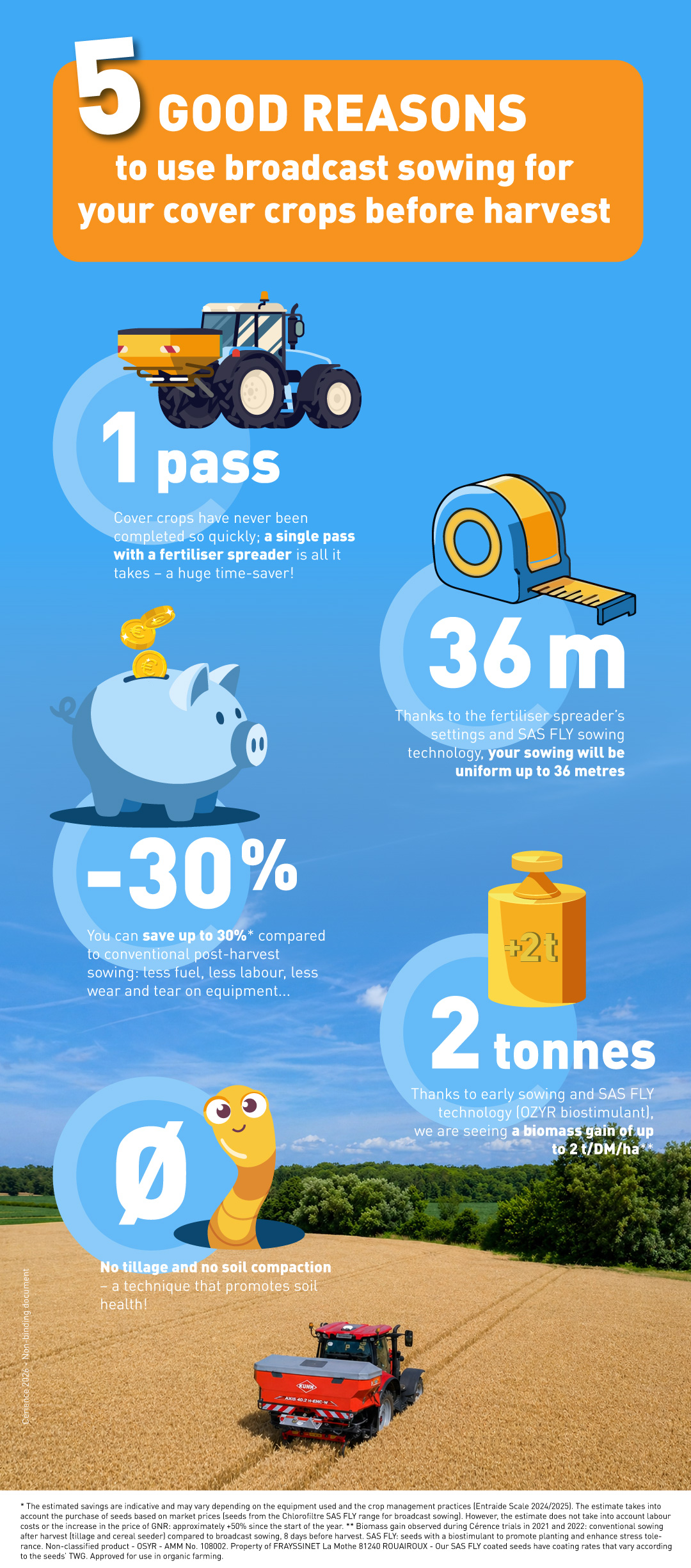
Broadcast sowing before harvest is now based on proven crop management practices, incorporating clearly identified points for attention: a short sowing window before harvest, chopped straw and the selection of clean fields. This mastery is reinforced by a rigorous selection of species and varieties suited to early summer sowing: rapid crop emergence and resistance to summer conditions. Still on the subject of seeds, multi-species cover crops are optimised thanks to SAS FLY technology, which standardises seed size and weight to ensure uniform spreading over wide swaths, up to 36 m. This seed pelleting process also incorporates a biostimulant (OSYR) to improve crop emergence and tolerance to water stress.
Finally, adjusting the spreaders has become simple and reliable! The leading manufacturers (Amazone, Bogballe, Kuhn, Sky… ) have included the SAS FLY range of cover crops in their adjustment tools; just a few clicks are all it takes to set up your spreader!
2. A significant time-saving during the summer growing period
By switching to broadcast sowing before harvest, the first noticeable benefit is the time saved. A single pass across the plot with a fertiliser spreader is sufficient to establish the cover crops, without the need for specialised equipment and without having to wait until the end of the harvest.
Whereas conventional sowing requires several successive operations (removal of straw, stubble cultivation, sowing, rolling, etc.), broadcast sowing allows you to get a head start on cover crop planting and free up valuable time for summer tasks. As soon as the harvest is complete, the plot is ready; see you in the autumn to remove the cover crop!
3. A 30%* cost saving
By reducing the number of operations, pre-harvest broadcast sowing generates direct savings. The use of a fertilizer spreader, which is usually already on the farm, limits equipment costs and wear and tear on machinery. Fuel consumption is significantly reduced and there is no labour requirement. Compared to a conventional post-harvest sowing regime, savings easily reach 30%*. This estimate includes the purchase of seeds (SAS FLY range) but excludes labour and fuel; potential savings that will add to the 30%!
Against a backdrop of rising costs, particularly for GNR and Nitrogen, this economic optimisation provides a practical way to ensure the profitability of catch crops without compromising on agronomic standards!
4. Higher biomass and nitrogen restitution
When sown before harvest, the cover crop benefits from a favourable microclimate for planting under the cereal canopy. After harvest, the cover crop benefits from residual soil moisture and the protection provided by the chopped straw. It thus gains a significant head start over cover crops sown after harvest. Furthermore, the SAS FLY seed pelleting, enriched with OSYR biostimulant, helps ensure successful crop emergence and stimulates root development in summer conditions.
Trials show that this combination of early sowing and SAS FLY technology results in better cover crop development. Compared to sowing after harvest, the cover crops will produce up to 2 tonnes more dry matter per hectare**!
This surplus biomass will translate in practical terms into a greater Nitrogen restitution to the subsequent crop as well, amounting to around 15 units of Nitrogen per tonne of additional biomass!
5. Sustainable agronomic benefits for the soil
Broadcast sowing before harvest is fully in line with the principle of reducing tillage, simplified cultivation techniques (SCT). With a single pass and no mechanical tillage, the number of interventions in the field drops drastically, which is beneficial for the soil: no compaction, preserved structure and enhanced biological activity!
Furthermore, early soil cover limits erosion and weed infestation and creates conditions favourable to biodiversity. By rapidly establishing catch crops, this technique helps to enhance the overall fertility of the plot and secure the potential of subsequent crops.
View the range of Chlorofiltre SAS FLY seeders
* The estimated savings are indicative and may vary depending on the equipment used and the crop management practices (Entraide 2024/2025 scale). The estimate takes into account the purchase of seeds based on market prices (seeds from the Chlorofiltre SAS FLY range for broadcast sowing). However, the estimate does not take into account labour costs or the increase in the price of GNR: approximately +50% since the start of the year.
** Biomass gain observed during Cérence trials in 2021 and 2022: conventional sowing after harvest (tillage and cereal seeder) compared to Broadcast sowing, 8 days before harvest.
SAS FLY: seeds with a biostimulant to promote planting and enhance stress tolerance. Non-classified product - OSYR - AMM No. 108002. Property of FRAYSSINET La Mothe 81240 ROUAIROUX - Our SAS FLY coated seeds have coating rates that vary according to the seeds’ TWG. Usable in organic farming.