
Broadcast sowing before harvest: simple, cost-effective and agronomically sound!
The cover crop establishment has become a key factor in preserving soil fertility, improving soil structure, limiting erosion and increasing the resilience of cropping systems. However, in practice, one of the main obstacles remains the very short window of opportunity available after the summer harvests: between straw management, stubble cultivation, sowing and other summer tasks, farmers often have little time to devote to cover crops.
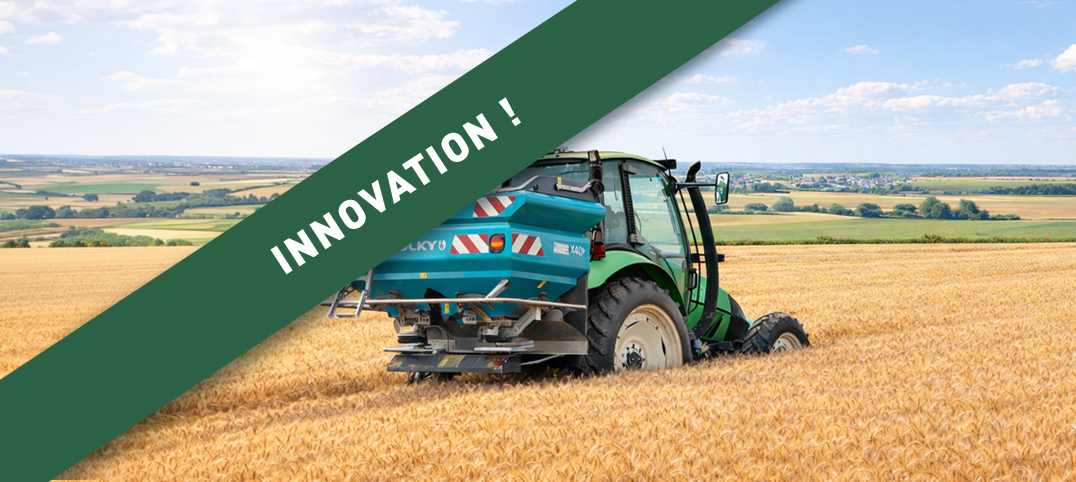
To address this constraint, a sowing technique is being revived and is revealing its full potential: it consists in broadcasting cover crops seeds in a standing crop, before harvest. Although still little known, this practice is now documented, tested and validated by an increasing number of farmers, technical bodies, and manufacturers of agricultural equipment (fertilizer spreaders). Finally, recent innovations in seed technologies, with SAS FLY technology, are enhancing the effectiveness of this practice and enabling its wider adoption. Let’s explore this topic in more detail.
A proven technique
Sowing cover crops before harvest: a simple, validated and tested technique
This technique consists in broadcasting the cover crops seeds in a standing crop (wheat or barley), few days before harvest. Contrary to popular belief, this method is neither experimental nor haphazard. Research conducted by ARVALIS shows that when sowing is carried out around ten days before harvest, the achieved cover crop emergence rates are equivalent to, or even higher than, the cover crops sown after harvest. This result is largely due to the maintenance of a humid microclimate beneath the cover of the still-standing cereals, whereas soil moisture drops sharply once the Harvester has passed.
The Greenotec and Agro-Transfert trials also demonstrate improved soil structure, better weed control and cost reduction for planting.
All you need is a fertilizer spreader!
One of the advantages of broadcast sowing before harvest is the simplicity of the operation. A centrifugal fertilizer spreader is all that is needed to carry out the sowing; a piece of equipment found on the vast majority of farms!
Conventional disc spreaders can achieve a uniform result if the settings are adapted to the seed, particularly over wide swaths. Research by Greenotec and Terraé highlights that the quality of seed ballistics plays a key role in the success of the operation, particularly when aiming for spreading widths of 24 to 36 metres. Some species naturally have good projection capacity, whilst others require seed pelleting to improve their ability to be broadcasted. This is particularly the case for multi-species cover crops. Cérience has chosen to coat the small seeds in the SAS FLY range in order to standardise the weight of the different species and thus ensure even spreading. For example, the Chlorofiltre Jet SAS FLY mixture consists of 55% bare hairy vetch seeds and 45% forage radish seeds coated using SAS FLY technology.
Finally, it should be noted that the cover crops treated with SAS FLY are listed in the calibration tools of the leading spreader manufacturers: Amazone, Kuhn, Sky, Bogballe, etc. It is therefore very easy to find the correct settings for your equipment based on the cover crops and the spreading width.
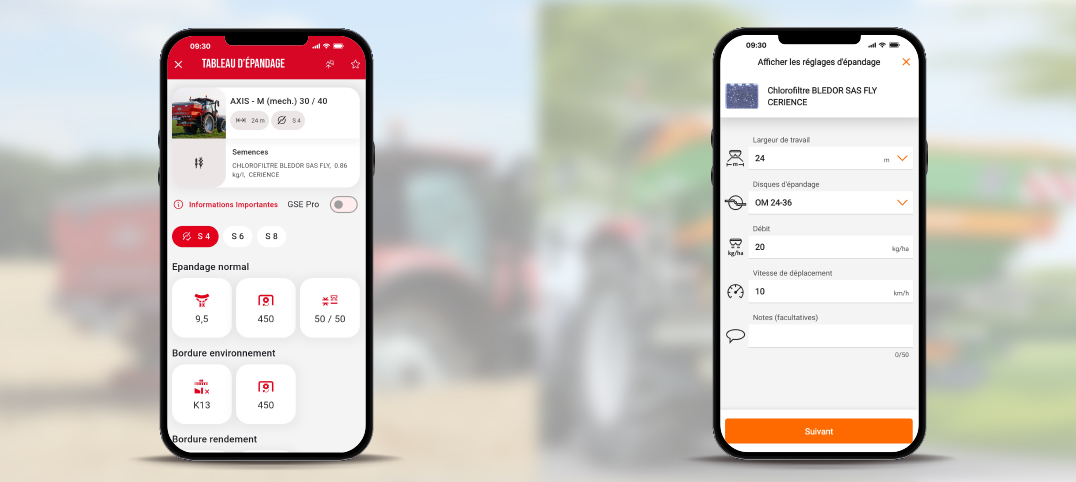
Examples of applications for configuring spreader settings: on the left, Kuhn (SpreadSet); on the right, Amazone (mySpreader).
Mustard, fodder radish and vetches are among the species best suited to seed broadcasting
Not all species are suitable for such a sowing technique. Small-seeded to medium-sized seeds, such as oil radish, foxtail millet, vetches or clovers, are particularly well adapted to broadcast sowing. Several ARVALIS trials show that species such as oil radish, vetch or mustard actually show a better crop emergence when sown before harvest rather than after, thanks to more favourable moisture conditions.
Conversely, large seeds such as beans or peas are more difficult to plant under these conditions, as they require closer seed-soil contact and better-controlled moisture levels.
A few key points to bear in mind
The technique of broadcast sowing before harvest is now well established, and certain points to watch out for have been clearly identified to ensure the success of the cover crops:
- Avoid fields with too much weed infestation, as weeds may compete with the cover crops and take over;
- Avoid sowing too early (several weeks before harvest), as this is more unpredictable and overgrown cover crops risk being damaged during harvest;
- During the harvest, prioritise mulching with chopped straw to maintain soil moisture.
Many economic and agronomic benefits
A very straightforward process
The main advantage of broadcast sowing before harvest is undoubtedly how easy it is to do. It requires a very basic equipment, often already available on the farm: a fertilizer spreader. And above all, the ‘job is done’ in one single pass!
This technique fits perfectly into strategies aiming to reduce mechanisation and is ideal for farms with remote fields.
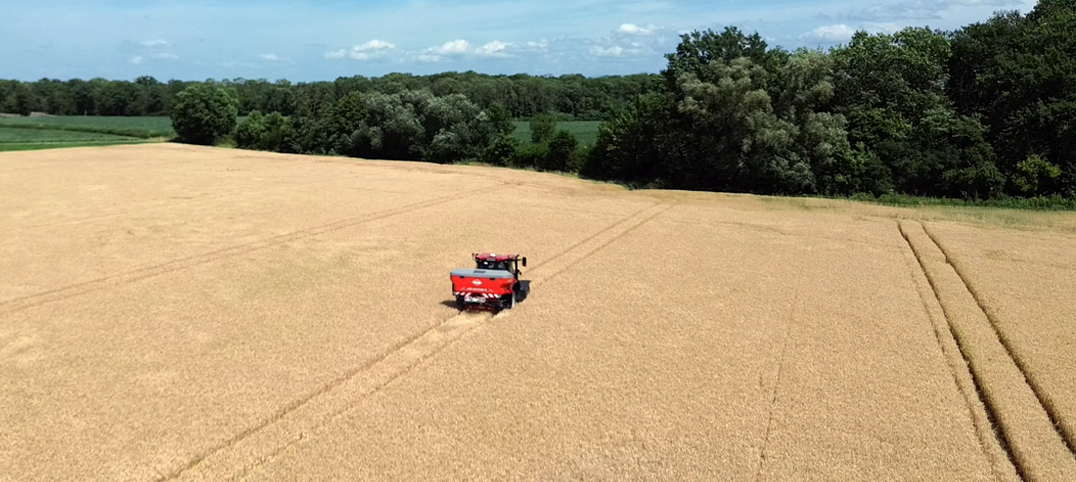
Above: Broadcast sowing of a cover crop from the SAS FLY range in a Wheat field, a few days before harvest.
A considerable time saving
From an organisational perspective, the time saved is significant. Whilst tasks usually pile up during the post-harvest period (Straw management, stubble cultivation, sowing of cover crops, rolling, etc.), seed broadcasting before harvest helps significantly to reduce the workload . By the end of June or early July, the plot has already been sown, living time free for other tasks or a well-deserved summer break!
- A single pass through the field;
- Very high work rate;
- A lighter post-harvest schedule.
Significantly lower planting costs
Another major advantage: opting for seed broadcasting represents a significant source of savings. Indeed, the simplicity and speed of the implementation process mean that several passes with machinery can be eliminated, thereby drastically reducing mechanisation, fuel and labour costs. And although the seeds prepared for this technique are slightly more expensive, the cost per hectare is significantly lower!
Compared to conventional sowing after harvest, cover crop seed broadcasting :
- Eliminates the need for multiple tool changes;
- Reduces labour costs;
- Reduces fuel consumption;
- Reduces equipment wear and tear.
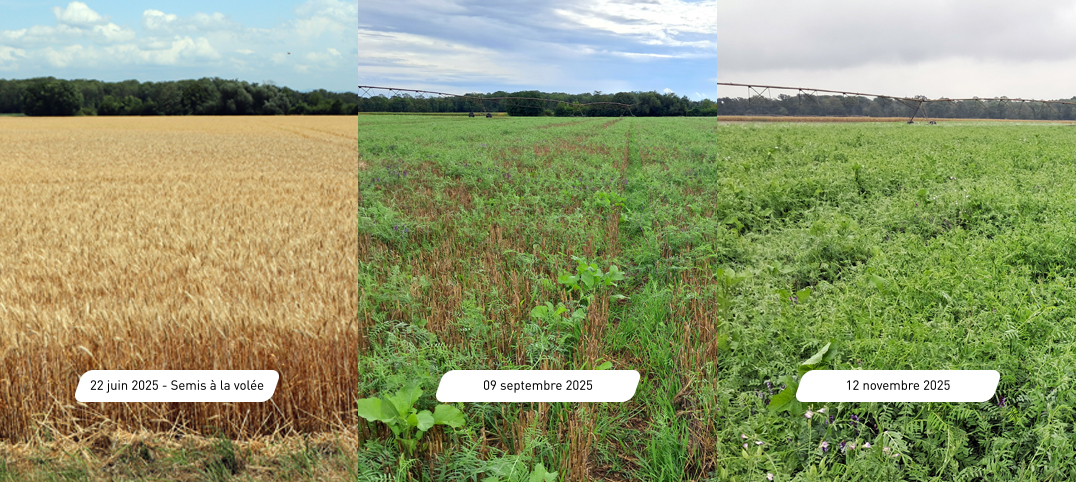
Above: growth of a SAS FLY cover crop sown by broadcast before harvest on 22 June 2025 in the Haut-Rhin (68).
Agronomic benefits and improved crop emergence for cover crops
In addition to the benefits associated with its implementation process, seed broadcasting offers advantages from an agronomic and crop management perspective. Indeed, this technique eliminates the need for tillage, thereby limiting soil compaction, which is beneficial for soil structure and biological activity.
Finally, practice shows very good cover crop establishment. Under sowing benefits from residual moisture that promotes germination. Crop emergence is often faster, particularly because the soil has not yet been exposed to the sudden post-harvest drying out. Once the straw is on the ground, it acts as a mulch that provides even greater protection for the young seedlings.
-No tillage or compaction of the soil;
-Promotes good soil structure and biological activity;
-Crop emergence equivalent to or higher than post-harvest sowing for several species (oil radish, mustard, vetch, etc.);
-Increased resilience to water stress thanks to the straw mulch left after harvest.
In summary:
Cover crops seed broadcasting before harvest in a standing crop is an innovative technique. It now benefits from well-established crop management practices, a suitable seed breeding, and optimised sowing quality thanks to SAS FLY seed technology.
In the face of economic and agronomic challenges, this technique offers farmers a genuine alternative for sowing their cover crops:
Quick and easy implementation process;
A significant cost reduction in mechanisation;
Valuable time saved during the busy harvest season;
Proper establishment of cover crops,
An agronomic advantage.
See SAS FLY cover crops mixtures portfolio
Sources: Arvalis – 06/2025 - Cover crops broadcasted before harvest: a technique making a comeback: https://www.arvalis.fr/infos-techniques/cover crops – sowing before harvest – a technique that is back in fashion Entraid – 06/2021 - How to broadcast cover crops seeds before harvest? : https://www.entraid.com/articles/semer-couverts-vegetaux-volee-avant-moisson ASBL Greenotec – 01/2024 - Cover crops seed broadcasting before harvest: https://www.terrae-agroecologie.be/fiches-synthese-technique/semis-de-couverts-la-volee-avant-moisson